From "Land Spirit Power"
First Nations at the National Gallery of Canada
Published 1992
Kay WalkingStick by Robert Houle
"It is not at all surprising that this New York-based artist would take abstract painting, a white male middle-class bastion of Platonic sensibility, as a way to express herself, because Kay WalkingStick is of Cherokee heritage, a matrilineal one. Thus, she is comfortable adopting the vocabulary of the dominant force of whichever society she works within at a given time. The Cherokee people refer to themelves as the "principal people." They viewed their lands as the centre of the Earth; and they adopted, in July 1827, at New Echota, their ancient capital, a constitution which acknowledged with humility and gratitude the goodness of the sovereign "Rule of the Universe."
WalkingStick has the distinction of having the same dignified circumspect deportment as her ancestors, and her abstract paintings are emblems of native subjectivity, their surfaces having many variables, which may retain or reject space. Density, opacity or lucidity is constructed into the history of each work. Often this is about overcoming the expectations of culture, of family, and of gender. She scratches away at her surfaces to reveal the encrustations of a history of painting that shows itself through a personal system of locators. Through this process, WalkingStick is not seeking an alluring surface, but an evocative one, filled with angst and controlled aggression. Her abstract landscapes, especially the earlier ones, have the strength and inner calm of a warrior combined with passionate execution and an aggressive stance. This emotional intensity directs the viewer to feel the subcutaneous layer of pain of someone who is preoccupied with the land in the way that only a member of a nation that has been dispossessed can be. One only has to remember the Cherokee "roundup and removal" which ended on 26 March 1839, leaving a tragic legacy of 4,000 silent graves lining the "trail of tears."" [Pg. 213]
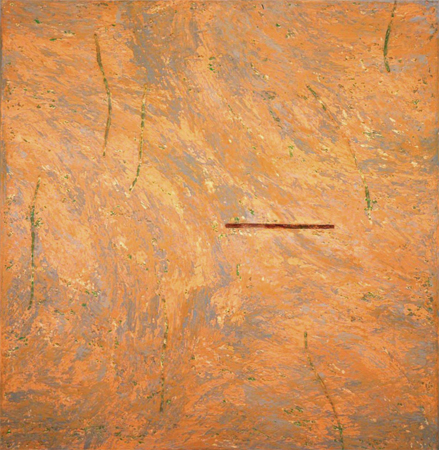 Montauk I, 1983, acrylic & wax on canvas, 56”h x 56”w Collection of The Forge Project Artwork and text © Kay WalkingStick 2022 Any use without written permission from Kay WalkingStick is strictly prohibited. |